Overriding Law: A pattern that connects

The Pattern that Connects

“… Gregory Bateson’s famous but somewhat mystical phrase raises as many questions as it attempts to address. In essence it is an appeal for holism – particularly the kind of holism that cybernetics specialises in: the reduction of the world to the interactions of recursive processes. In this sense, ‘pattern’ is an allusion to ‘abstraction’ – the description of a mechanism. Bateson himself created many abstractions: ‘double description’, ‘double bind’, ‘levels of learning’, ‘schizmogenesis’, etc. In his language, these things are seen to be patterns by virtue of the fact that they repeat themselves at different levels of recursion, and much of his work was focused on unpicking the presence of these patterns in biological, sociological, anthropological and mathematical/logical domains.

Holism, as understood by cybernetics, is precisely this identification of recursive repetition, or ‘patterning’. The cybernetic abstraction is the ‘explanatory principle’ (another Bateson term) which is applicable at many levels: a “defensible metaphor”, as Pask would say…”

Improvisational Blog – The pattern that connects

Overriding – Computational Example

“…Method overriding, in object-oriented programming, is a language feature that allows a subclass or child class to provide a specific implementation of a method that is already provided by one of its superclasses or parent classes. The implementation in the subclass overrides (replaces) the implementation in the superclass by providing a method that has same name, same parameters or signature, and same return type as the method in the parent class.[1] The version of a method that is executed will be determined by the objectthat is used to invoke it. If an object of a parent class is used to invoke the method, then the version in the parent class will be executed, but if an object of the subclass is used to invoke the method, then the version in the child class will be executed.[2]

Wikipedia – Method Overriding

What this is saying is that there are two Methods for Overriding, and the caller/programmer of the Methods can decide which one to choose. Both methods are present within the code, but only one will be used chosen by the programmer or runtime code flow.

Rationale for Knowledge Object

When considering Windrush across time we have a problem of understanding how the event could of occurred. There are thus far two reasons that have been put forward:

There was been a Ships registry which was being used until 2009/2010. Which was converted to disc, put in a cabinet somewhere and lost when moving to another building. Again, if the Registry was being used there would be no/or very few instances of deporting Windrush Citizens prior to that date – which is untrue.

The second reason that has been given is that the Windrush individuals didn’t have the necessary documentation to verify their legitimacy. This failure, like dye in the flow of water, has failed at the Home Office verification stage, failed at Court Tribunal stage, failed when ‘deport-first-appeal-later stage, failed with the ECHR – no cases made it there despite people allegedly abusing their rights. It should also be considered a failure of supporting Solicitors’ and Barristers’ as the Law (or Legal Right) was within the informational content until 2014, allegedly – when the Right was insidiously removed. The supposed ‘Activist Lawyers’ have been hoodwinked is the suggestion from these activities.

Yet mysteriously, somehow the Windrush group have been later found to have been capable of demonstrating validity.

The conundrum being how does an organisation act unlawfully (from about 2003/2004 the beginning of applied metrics and potential Cobra Effect) until 2014 which point in time its activities could then be considered lawful. The flow should be that Parliament decides the Law ..then.. the activities begin, not vice versa.

Overriding Law

“…Shadow Northern Ireland secretary, Louise Haigh, said it was “deeply concerning” that the prime minister “appeared to be undermining the legal obligations of his own deal” with the introduction of the new law while the negotiations are taking place….

…He asked Mr Lewis: “Will he assure us that nothing proposed in this legislation does or potentially might breach international obligations or international legal arrangements?”

The Northern Ireland secretary replied: “Yes. This does break international law in a very specific and limited way..

Sir Bob later told BBC Radio 4’s PM the decision was “troubling”, adding: “Britain is a country which prides itself on standing by the rule of law… whether it is inconvenient or convenient for us.

“Whatever we seek to do, if we find something we signed up to ‘inconvenient’, I am afraid this doesn’t mean we can renege on our contract… as that would damage our reputation long term.”

Brandon Lewis told the House of Commons that “there are clear precedents for the UK and other countries needing to consider their international obligations as circumstances change”.

That may suggest, says Catherine Barnard, professor of law at the University of Cambridge, that the government is looking at Article 62 of the Vienna Convention on the Law of Treaties, which enables a state to get out of its treaty obligations when circumstances change radically. 

But those changed circumstances have to be pretty dramatic – something like the dissolution of Yugoslavia, when a recognised country ceases to exist…”

BBC news – Northern Ireland Secretary admits new bill will ‘break international law’

Contract Law – Quotes

“…To conclude a future partnership, mutual trust and confidence are and will be necessary. ..”

European Commission – Statement by Michel Barnier following Round 8 of negotiations for a new partnership between the European Union and the United Kingdom

Mutual Trust and Confidence are conditions for a Contract to exist.

A Contract generally generally requires an interaction of three parts: An Offer, An Acceptance, and A Consideration. It can however, rely upon just the Offer and Acceptance providing the acceptee has already made moves towards accepting the Offer.

“…The Tory MP said it was “unconscionable” that the UK should seek to break international law by rewriting the withdrawal agreement with the European Union.

Writing in The Times, Mr Cox, who backed the Leave campaign, warned that he would not back the UK Internal Market Bill unless ministers dispel the impression they plan to “permanently and unilaterally” rewrite an international agreement.

The Independant – Geoffrey Cox says Boris Johnson’s plan to rewrite Brexit deal is ‘unconscionable’

There can be no ‘Unilateral alteration of Contract”. Especially by reneging or Overriding. These are the behaviours and resulting anarchy that serve the reasons for Contract Law to exist.

The Boundary-Power Universe

“…THE UK Government’s top legal adviser has been accused of producing “utterly risible” “first-term, first-year undergraduate tosh” in her attempts to defend Westminster’s international law-breaking Internal Market Bill.

In a statement published this afternoon, Suella Braverman, the Attorney General for England and Wales, says the bill will grant the Government powers which “may be exercised in a way that is incompatible with provisions of the Withdrawal Agreement”.

She also writes that the bill “expressly provides” for powers that “have effect notwithstanding any international or domestic law with which they may be incompatible or inconsistent”.

The National Scot – Westminster’s ‘utterly risible’ attempt to justify breaking international law

The Attorney General says that within the U.K. She can Override Law even though it has been through Parliament, and has a been agreed and written into Law by Parliament. Braverman also expects these antics to be applicable to foreign states/powers as an expression of symmetrical power.

“…In her memoirs, Margaret Thatcher identified the rule of law as the foundational underpinning of commercial confidence in any society. And in a 1982 interview she said that Britain gave the very idea of the rule of law to Europe. As she put it: “The law came from us.”

Thatcher also shared the view of her favourite lawyer, Lord Denning, that the law should uphold the keeping of promises. She extended this to upholding the obligations of international treaties too. In 1975, she told the Tory women’s conference that: “In the same way that government and individuals should be bound by law so countries should be bound by treaties.” She added: “Britain does not renounce treaties. Indeed, to do so would damage our own integrity as well as international relations.”

The Guardian – This Brexit bill finally buries the Conservative party of law and order

Lord Denning also mentioned, somewhere in the Noosphere, ‘that Law should be regarded as having overarching principles’. Which should be taken to mean not to wholly reliant upon semantics.

“…As Justice Secretary, Mr Buckland has faced calls to explain how the plans are consistent with obligations under international law and was pressed on Sunday over whether he would resign.

“If I see the rule of law being broken in a way I find unacceptable then of course I will go,” he told The Andrew Marr Show on the BBC…”

Hillingdon Times – Justice Secretary: I will resign if ministers break law in ‘unacceptable’ way

A Third parameter?! So now we have the Parliamentary agreed, written into Statute, both parties agreed …method. We also have the Overriding method with potential mistrust, breach of contract enforceable method. Unless the enforcing has also been Overridden.

The Third parameter being the opinion of acceptability. Which could be anywhere on a broad spectrum. Feels historical.

Incongruent Organisations

“…The article suggests that problems of structural incongruence ‐ and the tensions and conflicts that arise in connection with it as well as responses to these ‐ are major features of complex organizational and inter‐institutional arrangements. Moreover, it suggests that social order ‐ the shaping of congruent, meaningful experiences ‐ in these complex organizations as in most social life builds on non‐rational foundations such as rituals and non‐instrumental discourses. These contribute to maintaining social order and to providing a stable context, even for rational decision‐making and action…”

Wiley online library – Complex Social Organization: Multiple Organizing Modes, Structural Incongruence, and Mechanisms of Integration – Nora Machado, Tom R. Burns

“…Double bind-organisations themselves run the risk of self-destruction because the double bind-communication impedes learning, evolving and developing new solutions or adapting to the challenges of changing environments in time. The reason is that one side-effect of double bind-communication consists of ignoring errors as a chance for learning and, moreso, promoting the coverup of any dilemmas resulting from double bind-communication, thereby running a high risk that erroneous top-level-decisions could potentially ruin an organisation…”

Springer – Journal of Organisational design – How to avoid destroying your employees and organisations due to burnouts, braindrain and fading performance? Stop double bind-communication in your organisation!

“…The incongruent organisation, always on the defensive and closed to many experiences, finds itself ill at ease with its own self. It works hard at maintaining/protecting its self-concept. Because its way of being lacks authenticity, this work is difficult and such organisations can feel under constant threat. Distortion and denial arise to help in defending its self-concept. Distortion occurs when the organisation perceives a threat to its self-concept. The organisation distorts their perception until the (distorted) perception fits their self-concept.

Such defensive behaviour reduces the consciousness of the threat but not the threat itself. And so, as the threats mount, the work of protecting the self-concept becomes more difficult and the organisation becomes more defensive and rigid. If the incongruence is immoderate this process may lead the organisation to a state could be described as neurotic. Its functioning becomes impaired. If the situation worsens it is possible that the defenses cease to function altogether and the organisation becomes aware of its incongruence. Its manifest being may become disorganised and bizarre; irrational behavior, associated with earlier denied aspects of self, may erupt uncontrollably…”

Think DifferentShifting organisations to a better place

Incongruent Values

While incongruent values have the potential to create a vast array of potential polarised arguments, I wish to consider only one, the attendance to the Rule of Law and the behaviours or reasons that are willing to ignore or override that Law.

“…I have been watching  …. as Conservative ministers and MPs explain why it really would be all right if the British government broke the law…”

The Times – as Conservative ministers and MPs explain why it really would be all right if the British government broke the law.

“…The UK government’s law officer for Scotland, Lord Keen, has offered his resignation to the prime minister.

BBC Scotland understands the advocate general has found it difficult to reconcile plans to override the Brexit withdrawal agreement with the law…”

BBC News – Law officer ‘offers resignation’ over Brexit bill row

“…MPs backed the Internal Market Bill by 340 votes to 263.

…Two Tory MPs voted against the bill on Monday night – Sir Roger Gale and Andrew Percy – while a further 30 abstained, although some of those may not have been for political reasons…”

BBC News – Brexit: Internal Market Bill clears first hurdle in Commons

I’m sure somewhere I saw a Bill put forward from Anthony Magnall M.P. to do with voting against the party/whip. To curb rebellious M.P.s’. The question then being how much influence over the 30 abstentions did this have?

A disturbing 340 MPs are happy to Override law (breach contract/Treaty terms) and can reason it away as acceptable.

It could be considered that this is no more than brinkmanship, but this would only be true if no other behaviour could be found. If capricious overriding of Law is discovered, is that still brinkmanship?

“…Jessica Simor QC, the vice-chair of the council’s EU law committee, asked Braverman why “in the light of the extremely serious matters at issue, such advice [was not] sought from Treasury counsel, Sir James Eadie QC?”

Instead, she said, an opinion was sought from Guglielmo Verdirame QC, a professor of law at King’s College London, Richard Ekins, a professor of law and constitutional government at Oxford University, and Richard Howell, a barrister at Brick Court chambers in London…”

The Guardian – Brexit: barristers question selection of legal team leading UK drive to override deal

From a Contract Law perspective:

If the ‘breaking the Law in a small and limited way’ had not have been made public, then EU/Barnier would have continued in accordance with the original agreement and upon discovery of the override terms could continue with the original agreed contract. He can also retain anything has received from the arrangement, the other would have to return anything they have received.

With the overriding of the agreement the EU/Barnier cannot continue as they are now aware that the terms have been overridden. This would be enforceable as an acceptance of the new terms. He may choose this route, or add some changes of his own, although this would also have to be open to view.

The EU/Barnier could also ignore the Contract as it has now been broken with both parties being ‘returned to the original position’ as a guiding remedy.

Behaviour

“…The £1,200 in unlawful tribunal fees they imposed in order to lock low-income employees out of the justice system, and prevent them from receiving compensation from their bad bosses.

There was the sickening Tory abuse of people with mental health conditions, which extended to actually instructing government subcontractors to discriminate against them, which was unsurprisingly ruled unlawful in the courts.

Then there were Iain Duncan Smith’s brazenly unlawful forced-unpaid-labour schemes, which he didn’t even bother to present before parliament before enacting into law!

Once he was caught out illegally bypassing parliament to enact his nonsense legislation, he tried to retroactively change the forced-unpaid-labour rules so that they would have been lawful had they been written that way at the time. This cynical retroactive trickery was also ruled unlawful by the UK courts.

Another Angry Voice – post

Drivers -> System/Organisation

It’s hard to define the origins of a pathological organisation, and especially why members of the Organisation repeat and do what they are told to. Mostly, we are to believe that this is correct, it’s hard to argue otherwise, even when it isn’t strictly legal.

“…The emails seen by Newsnight encourage staff to reacquaint themselves with the code and says that if they are concerned they are “being asked to do something inappropriate by a fellow civil servant or a minister you should raise it with your line manager immediately”.

It is a very unusual move for senior civil servants to advise their colleagues to potentially refuse ministerial instruction.

BBC News – Brexit: Advice issued to civil servants worried about breaking law

Information – Structure: Institutional Racism.

Synthesis

Kettlewell’s moths

The Kettlewell’s moths example takes two coloration forms (variety/peppered and melanistic) and puts them in healthy and polluted environments of ecosystems. The selection mechanism being a Camouflage-Predator mechanism.

There is Information-Structure feedback process. The environment has a form of Information that is feedback to the Moth, and consequently the Moth has Information about itself which determines he moths fitness for that particular environment.

Phenotype Discrimination Model

With the Kettlewell’s moths example the environment pollution and the evolution of moth phenotype occurs concurrently. Neither moth form operates upon the environment to alter it in such a way that is detrimental to the other. Nor do they behave in any way that could be considered detrimental towards the other.

We are not considering moths, however. We are considering agents constructing environments for the sake of phenotype discrimination.

“…Macpherson defined institutional racism as: “The collective failure of an organisation to provide an appropriate and professional service to people because of their colour, culture, or ethnic origin. It can be seen or detected in processes, attitudes and behaviour which amount to discrimination through unwitting prejudice, ignorance, thoughtlessness and racist stereotyping which disadvantage minority ethnic people.”..”

The Windrush review is unequivocal: institutional racism played its part
Zubaida Haque

However, institutional racism is not only the awareness of another phenotype and creation of activities towards them. It is the machinery itself:

“…Wendy Williams, the HM inspector of constabulary appointed as the independent reviewer, has examined the key legislative, policy and operational decisions that led to the Windrush injustices, and spoken to those who suffered grave and catastrophic consequences from becoming entangled in the government’s hostile immigration policies…

…Neither that lesson of “unintended discrimination”, nor the definition of “institutional racism” from the Macpherson report, seem to have been learned by Britain’s policymakers and politicians. Not only is intent irrelevant for assessing whether policies are racially discriminatory, but race equality laws (including the 2000 Race Relations Amendment Act and the public sector equality duty) appear to have made little difference to immigration and citizenship policies affecting people from different ethnic groups…”

The Windrush review is unequivocal: institutional racism played its part

Meta Awareness

How would an agent phenotype respond to a discriminated environment from another?

“…In response to the findings, a consortium of 16 pressure groups called on Thursday for the Home Office’s immigration policies to be scrutinised to assess whether they are discriminatory…

…The report, which examined 69,000 official documents, noted that the Home Office does not have a large black and minority-ethnic workforce at senior level. “I think it is unfortunate that most of the policymakers were white and most of the people involved were black,” a senior official is quoted as saying in the report…”

Windrush report: call for inquiry into extent of racism in Home Office

“…The phrase “institutionally racist” was included in an early draft of the report but no longer appears in more recent versions, according to sources familiar with the review…

Publication of the report has been repeatedly delayed and previous leaked extracts found that the department was “reckless” and had developed a “defensive culture” over immigration policy.

The Times – Home Office is ‘institutionally racist’, said report into Windrush scandal

Errors of Omission / Commission

“… There are two possible types of decision-making mistakes, which are not equally easy to identify.

(1) Errors of commission: doing something that should not have been done.

(2) Errors of omission: not doing something that should have been done.

Coevolving inovations – David Ing

Umwelt – Patel

“…Patel’s response was awful. First she expressed outrage that Eshalomi was seemingly accusing the government of not understanding structural racism. (It’s hardly a surprise that a black MP put that charge to a home secretary who leads on the government’s hostile environment policy, which discriminated against the Windrush generation of black Britons, and whose compensation fund has paid out only a paltry sum so far.) Then Patel proceeded to list her own experiences of racism, including being called a Paki in the playground. “So when it comes to racism, sexism, tolerance or social justice, I will not take lectures from those on other side of the house.”

By implying Eshalomi’s concerns about structural racism against black people do not have a basis in reality and are motivated by bad faith, Patel gaslighted her. The Labour MPs who wrote to Patel about this were right to do so. Cue more gaslighting: “I will not be silenced by @UKLabour MPs who continue to dismiss the contributions of those who don’t conform to their view of how ethnic minorities should behave,” responded Patel.

Guardian – Priti Patel may have experienced one form of racism. That doesn’t mean she gets to dismiss others

Proclamations of being ‘Silenced’ and removing history (a predominant narrative from the Statue removal events) are a bit rich.

Of Windrush Documents

These are the MPs who voted to keep government Windrush documents secret

A total of 306 Conservative MPs opposed the motion, prompting shadow Home Secretary Diane Abbott to accuse Mrs May of missing an opportunity to start to “right the wrongs” done against the Windrush generation.

Benjamin Butterworth – inews – May 3 2018

“…Labour brought a vote to try to force the government to release information which they said would show how much ministers knew about the problems facing Windrush generation immigrants. 

MPs rejected the motion by 316 votes to 221, giving the government a majority of 94.

The Prime Minister pledged a “package of measures to bring transparency on the issue”, including a review which will have “full access” to Home Office information…”

The Scotsman – Full list of Tory MPs who voted to prevent release of Windrush documents

Of Non-Disclosure Agreements

“…Sajid Javid has been accused of trying to “buy the silence” of the Windrush generation by imposing non-disclosure agreements on citizens in return for fast-track compensation payments.

Labour claimed the home secretary had broken his promise to “do right” by those migrants from across the Commonwealth who were caught up in the scandal because they had problems proving their status.

Guardian Pippa Crerar – Sajid Javid accused of ‘buying silence’ of Windrush citizens

“…Earlier, Yvette Cooper, the chair of the Commons Home Affairs Committee (HASC), had said she was “extremely concerned” about the reports.

She said: “The home secretary has assured us that the Home Office will be transparent over Windrush – but using NDAs to hide things that have gone wrong cannot be justified. We will continue to pursue this.”..”

Independant – Benjamin Kentish – Home secretary under pressure over revelation government made Windrush citizen sign ‘totally unacceptable’ non-disclosure agreements

Cybernetics -Information Control

Inquiry overview

Given the disappearing- reappearing nature of ‘Governing Variables’, information, and processes is it possible the the system is using Cybernetic Information Control?

Cybernetic Regulation

  • Cybernetics is about the system moving to a goal “Where you want to get to”
  • Cyberneticians include “Bateson, Mead, Foerster, Weiner, and (Numan?).
  • The system and user “have a goal to get to” which may be at odds with where the system goal is going.
  • Ashby- a strong wind cannot correct the system steering.
  • Requisite Variety.
  • Tolerances – the system has to stay “within certain limits”.
  • More complexity/variety the “harder to build the system”.
  • Designing for conversations.
  • Design as a conversation
  • Can’t learn without conversation.

“…If it is a good regulator the passengers will have a smooth flight whatever the gustiness outside. They will, in short, be prevented from knowing whether or not it is gusty outside.  Thus a good pilot acts as a barrier against the transmission of that information…”

I thought the idea of a ‘Political Regulator’ was to create tipping points to alter the regulators function. Consider the notion of Kantian metrics and those who would choose to use them:

“…While there is a growing literature on “dark traits” (i.e., socially aversive traits), there has been a lack of integration with the burgeoning research literature on positive traits and fulfilling and growth-oriented outcomes in life. To help move the field toward greater integration, we contrasted the nomological network of the Dark Triad (a well-studied cluster of socially aversive traits) with the nomological network of the Light Triad, measured by the 12-item Light Triad Scale (LTS). The LTS is a first draft measure of a loving and beneficent orientation toward others (“everyday saints”) that consists of three facets: Kantianism(treating people as ends unto themselves), Humanism (valuing the dignity and worth of each individual), and Faith in Humanity (believing in the fundamental goodness of humans). Across four demographically diverse samples (N = 1,518), the LTS demonstrated excellent reliability and validity, predicting life satisfaction and a wide range of growth-oriented and self-transcendent outcomes above and beyond existing measures of personality. In contrast, the Dark Triad was negatively associated with life satisfaction and growth-oriented outcomes, and showed stronger linkages to selfish, exploitative, aggressive, and socially aversive outcomes. This exploratory study of the contrasting nomological networks of the Light vs. Dark Triad provides several ways forward for more principled and data driven approaches to explore both the malevolent and beneficent sides of human nature…”

The Light vs. Dark Triad of Personality: Contrasting Two Very Different Profiles of Human Nature – Kaufman, Yaden, Hyde and Tsukayama.

“…The same argument applies to an air-conditioner.  If I live in an air-conditioned room, and can tell, by the hotness of the room, that it is getting hot outside, then that conditioner is failing as a regulator.  If it is really good, and the blinds are drawn, I shall be unable to form any idea of what the outside weather is like.  The good conditioner blocks the flow inwards of information about the weather…”

Cybernetics • Regulation In Biological Systems • Selection 8

Internally insulated with no external information in the regulated environment. I don’t remember that happening.

“…In general, then, an essential feature of the good regulator is that it blocks the flow of variety from disturbances to essential variables...”

Cybernetics • Regulation In Biological Systems • Selection 8

To preserve the variables? What if I want to change them?

  • “Feedback… information as an abstraction”.
  • “A vibrant community in Europe, but its more about application than theory”.
  • Pangaro – “Design for conversations applying to: advertising/marketing, interaction design and software products..”

“…In the last selection we found Ashby making what may strike us initially as a surprising inference.  Starting from the assumption that “an essential function of F as a regulator is that it shall block the transmission of variety from disturbance to essential variable” he draws the conclusion that “the regulator’s function is to block the flow of information”.

… But we need to keep one thing in mind.  When we speak of the regulator blocking the flow of information, we are talking about the whole system (D,F,E) as a “black box”, where the net information flow from input to output is as low as possible.  When we turn to a finer-grained analysis of regulated systems we will see that all sorts of information has to be processed inside the system in order to achieve its mission…”

Cybernetics • Regulation In Biological Systems • Discussion 2

Meta-System

Causal Regulator Diagram

I would suggest taking ‘D’ as the skills shortage and all the narratives that support the shaping of ‘D’ which would include the input indicator.

‘E’ then would be the current sink, for want of a better expression, or stock as in stock-flow diagram. Where ‘E’ is an input.

Where ‘E’ is an output. The narrative for support of the conditions of that output.

“…On what scale can any particular mechanism F be measured for its value or success as a regulator?  ..”

Cybernetics • Regulation In Biological Systems • Selection 6

The way I remember the Tao say, is that changing a Tragedy of the Commons archetype from a positive to a negative archetype created the hubristic means for collapse of the system. That, however would also introduce the unswerving correctness of cultural hegemony.

“…There are intellectual as well as moral and political reasons for the rediscovery of Gramsci…”

The Concept of Cultural Hegemony: Problems and Possibilities – T.J. Jackson Lears

Briefly, there are questions as to the nature of information namely the process thinking of Bayesian updating. The positive and negative emergence of the education system. So I would probably go and check say A-level tests. There would be no point in looking at maths because this is procedural with rules and semantics, but philosophy should be more cognitive.

Some years back the Philosophy A-Level had a curriculum change to solely religious philosophical content. It did so for a year and after receiving criticism changed. The conundrum is: if information that is rote learned, is that belief in that information, and therefore the belief in the system, good or bad? What difference does it make?

Misinformation, Disinformation and Propaganda.

“…Disinformation is false information spread deliberately to deceive.[1][2][3] This is a subset of misinformation, which also may be unintentional…”

Disinformation – Wikipedia

“… Misinformation: information that is false, but which may be believed by the person spreading it, or posted in good faith. It can also be posted in “bad faith,” or with a political goal in mind, but be believed to be true at the same time.

Disinformation: false information which the person spreading it knows to be false.

Misinformation and Disinformation – Storyful Intelligence – September 24, 2018

The trouble with Misinformation is that the probability of it being Disinformation increases with the identification of a system using Cybernetic Information Control. However, when contemplating an additional construct of information – a label – that never actually existed one has to wonder as to whether the level of ‘information abstract form’ interpretation is correct.

I have had to reverse engineer, to some extent, as to whether Information Control is operating and how. So I’ve gone to look for what ground work Bateson would have laid out in, broadly speaking, Metaphysics and Phenomenology.

It turns out that Bateson was with the OSS during WWII, which is now the Home Office, and was involved in Psychological Operations. Which I think I probably need to bring into the frame.

Psychological Warfare

“…Psychological operations (psych-ops or psy-ops) refer to the planned use of psychological knowledge to influence groups, organizations or populations to act in certain ways…”

The methodologies developed for psy-ops provide a knowledge base for: executives considering major organizational change, managers who wish to comprehend political realities, people who wish to recognize organizational strategies, leaders who wish to protect the interests of an organization.

What is Psychological Warfare?

– using propaganda to demoralize an enemy in war, including civilian populations

– using psychological tactics to disadvantage an opponent, e.g. causing fear

Psychological Operations : Psy-Ops

Most Disturbing of all “…Psychological operations seem to be most effective with people who…”

  • trust authorities

  • have little education

  • accept information uncritically

  • want to believe the propaganda

  • benefit from the proposed change

  • do not wish to understand their own motivations

3rd Order Cybernetics

What I have been doing here is elaborating regulator obstruction and use of information as a cybernetic device. First-order cybernetics will be largely unknown until it happens. Second order cybernetics is merely the interaction with the system, say.

For example Skinner’s box in first order cybernetic terms occurs first conceptually – what is in Skinner’s mind – then by construction; the Skinner box. The rat, mouse, or pigeon is the second order agent and validates the behavioural conditioning be it positive or negative operant conditioning.

However, it is not Skinner or his concept, nor box alone that proves the system. Nor is it the mouse pressing the lever that validates the system. It is only the capacity to move to a third-order position and watch the researcher operate the box to change the conditioned behaviour of the mouse. Thus, to view first and second order interactions proves the system to the observer. I think the pennies dropped with a few. That’ll do.

Therefore, the corona of third-order observations defines an abstract (or GST) theory of operation.

  • Conversation is the minimal ‘ethical interface’ where conversation means reliable transparency of action and intent – what and why across the interface.
  • Conversation is the minimal humane interface growing the understanding and informing the action of one or more willing and active participants.
  • Cybernetic design = design for conversation
  • “I shall act always so as to increase the total number of choices” – Ethical imperative Heinz von Foerster.

I’m not convinced that we are always making correct discrimination between the ‘Good regulator’ and the ‘Ethical regulator”.

The ‘Design for conversation’ is at least neutral in this regard.

Transactional Analysis

I’m limited in what I can write here because a new wrapper, or narrative, awaits for cybernetic purposes. Design for conversation… for a Teleological Cybernetic system?

Context: Process

Action Research

Author – Diane Taylor:

Man whose wife died after deportation attempt fights removal order.


“…It has emerged that the failed removal last year was part of the Home Office’s target-driven programme Operation Perceptor. This came to light when Motsamai requested the Home Office files for him and his wife. They were so heavily redacted that entire pages were blacked out.
The Home Office had a target of 12,800 enforced removals for the year 2017-18. Operation Perceptor targeted people who, like the Motsamais, did not have blood relatives in the UK, as they were perceived to be easier to remove quickly….

…Motsamai had had problems with the Home Office before. He arrived in the UK in 2004 to do a business studies course. In 2008 he was refused permission to extend his visa and was removed back to South Africa, but in March 2009 an immigration judge ruled he had been unlawfully removed and he could return to the UK.
The judge described Motsamai’s treatment as “abrupt and harsh” and said of the Home Office’s removal document: “The document is neither signed nor dated and I have no doubt that it was never sent. It contains an error. The decision was never served on him so he couldn’t appeal. I find that the decision of the secretary of state to remove him was not in accordance with the law.”

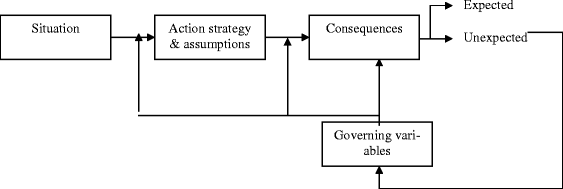
Lens 1 : Argyris and Schon

“…Organisations, teams, and individuals (including ourselves) have a habit of claiming to operate according to a set of theories that apply to our work. With the best of intentions, we set out to do our business based on a set of assumptions we would like to be true.

In fact, observation of what actually happens will usually reveal something different. In a perspective first articulated by Chris Argyris, we operate according to a rather different set of assumptions—our “theories in use.” It’s these theories-in-use that govern what is really done.

For example, espoused theories might be around customer service. In some organisations, unfortunately, the theories in use might have more to do with profit maximisation. The result is a debilitating disconnection between what management claims to be about and what it’s really about.

When challenged on this, leaders will typically resist admitting what drives them isn’t what they would like it to be. Their ego won’t let them...”

Dr David Fraser – What’s the difference between espoused theories and theories in use?
Double-loop learning
Action Research: Behaviour
Stuart French – Creating Knowledge Cultures

Action Research: Information Difference.
Max Viser, Kim Van der Togt: Learning in Public Sector Organizations: A Theory of Action Approach

Lens 2: Otto Scharmer

Lens 3: Ashby’s Controller

“…The design of a complex regulator often includes the making of a model of the system to be regulated. The making of such a model has hitherto been regarded as optional, as merely one of many possible ways.

[In] this paper a theorem is presented which shows, under very broad conditions, that any regulator that is maximally both successful and simple must be isomorphic with the system being regulated. (The exact assumptions are given.) Making a model is thus necessary….

…The reader may be wondering why error-controlled regulation has been omitted, but there has been no omission. Everything said so far is equally true of this case; for if the cause-effect linkages are as in fig. 2…

…R it is still receiving information about D’s values, as in fig. 1, but is receiving it after a coding through S….”

Roger C. Conant – EVERY GOOD REGULATOR OF A SYSTEM MUST BE A MODEL OF THAT SYSTEM

Ashby’s Controller (Goal Level) <-> Requisite Variety (Informational Blarney).

“…In sociology, an isomorphism is a similarity of the processes or structure of one organization to those of another, be it the result of imitation or independent development under similar constraints. There are three main types of institutional isomorphism: normativecoercive and mimetic.[1] The development that these three types of isomorphism promote can also create isomorphic paradoxes that hinder such development. Specifically, these isomorphic paradoxes are related to an organization’s remit, resources, accountability, and professionalization…”

Isomorphism – Wikipedia

Lens 4: Pure Cybernetics

“…The functional (content and meaning) role of information in cybernetic processes cannot be directly measured with Claude Shannon’s statistical approach, which Wiener also adopted. Although so‐called Shannon information has made many valuable contributions and has many important uses, it is blind to the functional properties of information. Recently, we proposed a radically different approach to information theory. After briefly critiquing the literature in information theory, this new kind of cybernetic information will be described. We call it ‘control information’. Control information is not a thing or a mechanism but an attribute of the relationships between things. It is defined as: the capacity (know how) to control the acquisition, disposition and utilization of matter/energy in ‘purposive’ (cybernetic) processes….”

Peter A. Corning – Control information theory: the ‘missing link’ in the science of cybernetics.

Therefore….

Diagram

Hard Systems – Process

Overview

I wanted to get a Hard-Systems view nailed down first, mainly because dealing with Falsification or High-Order Propositions maybe redundant. Furthermore, a method to define a Cause-Effect relationship could resolve some of the Logic arguments that have occurred, or that will occur.

On second thoughts. The relation that has been given as a rule of inference is of the form p->q (p implies/infers q). The problem is that the rules of inference, four of them I seem to recollect, of which I only know of two: Modus Ponens and Modus Tollens. So, p->System->q would be true with the proviso of p->System relationships. At least I think thats the assertion/idea.

While the block diagram below illustrates how the process is represented and filled in [as in (C)], it will also allow further expansion by adding other blocks.

Veracity Of Whistleblower claims

Recently there were two articles published in the Guardian newspaper giving an insight into the Home Office as a Process. I have instantly taken or believed it to be true, not as a product of a Malevolent Demon, but because events in the environment equate to a Cause-Effect pair.

Why query this? Well, not so long ago there was another hullabaloo involving whether the Windrush registry had been lost or destroyed with assurances that prior to its destruction it had been used. At the time this seemed plausible although, as the story unfolded, it no longer adds up.

The reason being if the registry had been used it would have resulted in no Windrush detentions or deportations prior to its destruction. One could say that there would have still of been a few errors, but instead half of those detained or deported from Windrush occurred prior to the Registry’s destruction/loss. In other words, the registry was not significant in the alteration of occurrences to the Windrush group. No turning point – graphically speaking.

Discernable Pathologies

One of the questions that arises is whether the organisation operates fractally or hierarchically. The reason is that the Effects (I’m not sure that its Emergence strictly speaking) suggest a simple rule of operation structure whilst making it clear that it should be considered an example of a Stovepiped Organisation. So, is this notion possible;

“…Top-down hierarchies are typically characterised by command-and-control systems of authority that often create harmful stress and internal competition for advancement within organisations. The pervading perception is of ‘limited room at the top’, where positions of authority become scarce resources. Members withhold or hoard information by focusing competition energy internally rather than externally, creating silos of information and causing negative stress that is reflected in absenteeism and higher healthcare costs. Voluntary turnover drains talent as creative individuals tire of the politics and seek harmonious work environments. ‘Change management’ is an issue, as members’ natural compulsion to provide feedback and insights is quashed by management dictates…”

Janna Raye – Fractal Organisation Theory

The Abstract compares Hierarchal Organisations, and their symptoms to Fractal Organisations. Its clear that the Fractal Organisation is not in use here, and I wonder whether the Fractal Organisation has principles similar to the Stovepiped Organisation remedies?

“….Creating Silos of Information…” I missed that the first read through.

Perhaps at this juncture the article for comparison:

‘Toxic atmosphere’: the Home Office unit everybody wants to leave. Whistleblowers say bullying culture is causing chaos in department that handles asylum claims.

Amelia Hill – Guardian

What is still coming up short are the Fractal effects without being a Fractal Organisation. Although it is very much a process thinking Organisation.

“….As our research related to sustainability has progressed, we have realized that knowledge is not the prime problem. We believe that the ruling paradigm of science, engineering and policy needs to be critically evaluated. This paradigm holds that everything can be reduced to the tiniest particles which interact in a clockwork-like fashion. However, new discoveries have lead to the concept of ‘systems thinking’. Systems thinking is particularly important in dealing with our environmental problems and other large-scale open-ended problems. But is systems thinking sufficient? We intend to show that systems thinking is a major step in the right direction, but it is insufficient in handling the increasing environmental problems of our planet. We believe that ‘process thinking’ is a better paradigm due to the profound importance of change and continuous improvement. The superficial understanding of change in science and engineering has, in our opinion, resulted in what we call the ‘Dogmas of Science and Engineering’ which are the main roots of our problems. A new paradigm must therefore violate these dogmas for mankind to overcome the problems we are facing. This new paradigm must permeate the whole of society as well, and hence both scientific and political leadership is crucial…”

Process thinking — a new paradigm for science and engineering
Author links open overlay panelJanEmblemsvåga BertBrasb
Show more
https://doi.org/10.1016/S0016-3287(00)00013-6

“…a new paradigm must violate these dogmas..” violate as in Boundary Spanners or violate as in for the sake of poor statistical justification? The second Whistleblower article for comparison.

“…Home Office chaos and incompetence lead to unlawful detentions, claim whistleblowers..”

Amelia Hill – Guardian

It’s not difficult to elicit a set of Causes from these articles and begin to derive a process that is detached from the legitimate process as a ‘violation’. Which will then tend from hard-systems to soft-systems and coercive systems.

There is a further implication to System of Systems, namely that the underlying rules being put in place create similar Emergence across other Systems. Go figure.

Feedback Control Diagram

What would occur in a Hard-System would be that the Sensor deviations (“the difference that makes a difference”) would be fed back into the input, termed Measurements on the diagram. With the difference corrected at the Comparator (the minus sign indicates negative feedback).

It would seem that the Comparator sits in an Environment of its own making, and is therefore subject to other ‘positive’ feedback.

stack exchange – controller block diagram

A Government that proclaims Minarchy, practices Interventionism. Should that go into an O.R. handbook, under the heading Bullshit Government?

Soft-Sensors: Conceptual Lens

Overview

I thought that perhaps an explanation of soft-sensors and a rationale to construction or understanding as to how ‘I’ would use the … Lens.. for want of a better expression. Therefore some definitions of Soft-sensors:

Soft-Sensors

“….Soft sensors are inferential estimators, drawing conclusions from process observations when hardware sensors are unavailable or unsuitable; they have an important auxiliary role in sensor validation when performance declines through senescence or fault accumulation…”

Soft Sensors for Monitoring and Control of Industrial Processes
Authors: Fortuna, L., Graziani, S., Rizzo, A., Xibilia, M.G

“….Soft-Sensor provides estimates of process variables of interest in situation where those variables cannot be measured at all or frequently enough using classical instrumentation due to economical or technological limitations, like lack of space, harsh environmental conditions, extreme operational conditions…..

…Models used in Soft-Sensors represent the knowledge of the system that is exploited to improve the quality of measurements. The models complexity needed varies depending on the goals of the Soft-Sensor development and the complexity of the system, ranging from none to thousands of dynamic variables…

….The models may be based on: 1) the knowledge of the physical processes governing the behaviour of the process variables of interest – so called first principles models or white-box models, or 2) identified from the system’s operational data with little insight into the system structure – so called black-box models, or 3) mixed grey-box models merging the two previous approaches…”

Soft-sensor Measurement and Estimation Technology

I think that this should be left with some ambiguity, for the sake of creative use. However, the outline is that a set of failure data will infer a common cause.

Perhaps, it would be worth considering that the history of intelligence [e.g. Spearman, Thompson, and Binet] charts a movement of diagnosis of facets of intelligence, diagnosis for improvement, and shift to measurement to stratify society.

Subjective Truth to Gemba

The notion of Subjective Truth alone won’t be considered relevant due to being opinions, beliefs and/or bias. However, the most striking method would be where an individual has been differentiated against by the System and to be later found to have been unduly Judged by the System. At which point their Subjective Truth becomes highly pertinent, and Their experience, I would suggest, equivalent to Gemba.

“…Gemba (現場, also spelt less commonly as genba) is a japanese term meaning “the real place.” Japanese police could refer to a crime scene as gemba, and TV reporters often refer to themselves as reporting live from gemba. 
In business, however, gemba refers to the place where value is created. The most common use of the term is in manufacturing, where the gemba is the factory floor. Beyond this, gemba can really be any “site”, such as a building site in construction, the sales floor in retail, or somewhere the service provider interacts directly with the customer e.g. a car dealership showroom….

…In lean manufacturing, the whole point of gemba is that problems in a business process or production line are often easily visible, and the best improvement come from going to ‘the real place’, where leaders can see the state of the process for themselves….

…Over the course of a Gemba Walk, leaders, managers and supervisors are expected to simply observe and understand process. As part of the Kaizen methodology, it is also supposed to encourage greater communication, transparency and trust between the lower-level of employees and leadership. For this reason, it is not appropriate to use a Gemba walk to point out employee flaws, or enforce policy – this runs the risk of employees putting up barriers to leadership, or closing off altogether…”

What is Gemba: Definitions and tools – Business Transformation & Operational Excellence

Relative Truth to Triangulation

“…In the social sciencestriangulation refers to the application and combination of several research methods in the study of the same phenomenon.[1] By combining multiple observers, theories, methods, and empirical materials, researchers hope to overcome the weakness or intrinsic biases and the problems that come from single method, single-observer and single-theory studies….
In particular:
– It can be used in both quantitative (validation) and qualitative (inquiry) studies.
– It is a method-appropriate strategy of founding the credibility of qualitative analyses.
– It becomes an alternative to traditional criteria like reliability and validity.
– It is the preferred line in the social sciences.

The purpose of triangulation in qualitative research is to increase the credibility and validity of the results. Several scholars have aimed to define triangulation throughout the years.
Cohen and Manion (2000) define triangulation as an “attempt to map out, or explain more fully, the richness and complexity of human behavior by studying it from more than one standpoint.”[3]
Altrichter et al. (2008) contend that triangulation “gives a more detailed and balanced picture of the situation.”[4]
According to O’Donoghue and Punch (2003), triangulation is a “method of cross-checking data from multiple sources to search for regularities in the research data.”

Wikipedia – Triangulation [Social Science]

Effect -> Cause : Ishikawa diagrams

If you want to discover the root cause of a problem and need a structured method to guide a team through a problem solving process, then the cause and effect diagram is for you. The tool allows a team to identify, explore and display in increasing detail, all of the possible causes of a problem, to eventually flush out the root cause(s) of the problem.

The process to follow is basically the same, regardless of industry or problem. It’s best to gather a team of people who have the right skills, knowledge and experience of the problem to collectively identify all the reasons why the problem may be occurring.

If you can’t quantify your problem, consider collecting some data before you go any further. Remember, you’re aiming to separate fact from opinion and identify the root cause of the problem.

Lyndsay Swinton – Management for the Rest of Us

Limitations

I don’t quite know what to call the scope of this outline, but it should become apparent that it will be subject to a broader System.

Firstly, there are those that will have been banjaxed by dodgy process, and secondly there’s the information System, of which relates to Context. All that Soft-sensors achieve is to infer a root cause which will tend towards – process, and information systems, I suspect.

Perhaps the question is Intentionality?

Soft Sensors : Concept to Chaos

Primordeal Conceptual Soup

I wanted to explore a different kind of Homeostasis or equilibrium as one of Theory of Belief system. Where a Belief System is made up out of elements (I can’t elaborate upon the particular research, I have looked for it several times since finding it and reflecting). As the elements become Assumptions (with inferred probability or Certainty Factors) the old theory begins to break down.

The Theory/paradigm has connectivity to forms of reasoning. I wanted to consider the diagram of Deductive and Inductive reasoning below and the imbalances caused from one form of reasoning to the other. Usually, I personally would have considered just one form of reasoning occurring for a given problem, and generally deductive. I’m just not in a position to contemplate anything inductively because I am generally the recipient of a theory or the information based upon a theory/belief/framework, whatever the case maybe.

I think there is more to this diagram than I have usually considered; as a population for instance. Where the espoused Theory is providing Observable errors. Or where an institution is the encapsulation of a Theory (Theory in Use vs Espoused Theory). Or where a body of experts operate from within an expiring Theoretical frame.

Daniel Miessler
The Difference Between Deductive and Inductive Reasoning

I’d really like to steal out large bodies of quotes from the diagram origins, but it should probably be referred to from the link. I don’t know what copyrights exist here and its a good article, well thought out, and worth the read.

Its seems more like a microcosm of an Asymmetric World. Sophism vis-a-vis Scepticism again; that broken theory moment. I think that it should be pointed out that Scepticism has equivalence to Inductive Reasoning and that while Deductive reasoning is relatively easy, I have often wondered how Inductive Reasoning works. Mainly because its the Information and Subjective position of Uncertainty – where reality is a bit slippery and Theories are constantly being forced by those most interested in maintaining the current operating machinery.

The most notable aspects seem to be: Warm Data, Triadic Relations, Semiotics, Qualitative perspectives/case studies, and Nemetics. At least, this is what immediately springs to mind.

Equally as relevant would be a pointer to Kuhn’s Paradigm shift I think, where the diagram (Stock-Flow) captures the population dynamic as the Theory’s credibility wanes.

There is a reference to a Thermodynamic model and use of entropy, which I don’t personally like (Where I have implied that there is an alternate view, in the first sentence, with regard to Homeostasis and equilibrium). The reason is that this would imply Annealing and changes in the structure of the lattice. To me anyway, which also suggests how it gets to a Theory-in-use vs Espoused theory riddle – at this point in time. Also, it would take a lot of heat/energy to change the shape?

Supportive Evidence

The following fragments are primarily taken to support the aforementioned shift/collapse of the espoused theory/paradigm.

Reality – Theoretical Collapse

“…Chaos, incompetence and bullying of Home Office employees are resulting in failed deportations and the unlawful detention of vulnerable and desperate people, whistleblowers allege…

“Mistakes by overworked, under-skilled, bullied and highly stressed DCT caseworkers are directly and frequently leading to immigration detentions that are later proved to be unlawful,” claimed one source….

Whistleblowers also allege that:
– Decisions on whether an applicant can stay in the UK, supposed to take six months, frequently take two years. During this time, applicants are in limbo, unable to work or rent property.
– People who have sought asylum are frequently unlawfully detained for up to six weeks in immigration removal centres.
– Personal performance targets indirectly encourage employees to reject applications without fully examining whether people have the right to remain in the UK.
– People with a strong case to remain in the UK are deported because of poor decisions made by insufficiently trained staff.
– Flights for deportations are frequently cancelled when asylum seekers protest on board and pilots refuse to fly…”

https://www.theguardian.com/uk-news/2019/apr/28/home-office-chaos-and-incompetence-leads-to-unlawful-detentions-claim-whistleblowers

Student Category compared to the Windrush Category

“…Campaigners representing students contesting the Home Office’s allegation of cheating say most of those affected have been made unwell by the prolonged strain of attempting to prove their innocence. Many have been pushed into destitution. The organisation Migrant Voice, which has worked with dozens of those affected, says many have contemplated or attempted suicide.
Mike Gapes, the MP for Ilford South, who has advised a number of affected people in his constituency, describes this as “a bigger scandal than Windrush in terms of the number of individuals removed from the country and whose livelihoods are being destroyed by anguish and despair”. The issue has its roots in the same period at the Home Office under May, when officials were developing the hostile environment, under pressure to reduce net migration to the tens of thousands and show voters that the government was taking firm steps to control illegal immigration…

Stephen Timms, the Labour MP for East Ham, is sceptical about these findings. “It think it’s nonsense. There is no way that 90% of those who sat the test were cheating. Do they really believe they were presiding over a system in which over 90% were cheating? It doesn’t make sense. It’s completely implausible…”

https://www.theguardian.com/uk-news/2019/apr/23/toeic-english-test-sajid-javid-urged-to-act-in-immigration-scandal-bigger-than-windrush

Of Reform – Opinion

“…Since Windrush, all we have seen is pathetic attempts at compensating victims, and more scandals. Presiding over it all is the new benevolent dictator Sajid Javid, who speaks in the language of a man who knows how to pay lip service to the forces that removed his predecessor, while doubling down on policies that have not changed, but are merely fronted by a new, more media-friendly face. One that does not hesitate to point out – as often as possible – that it is a brown one.
What will it take for wholesale reform? What will it take for the Conservative party to understand that its combination of anti-immigration extremism and incompetence is cruel but also bad for the economy, the NHS and the higher education system?…”

https://www.theguardian.com/commentisfree/2019/apr/30/home-office-tory-policy-ruin-scandal-british-economy

Of Law

“…The laws are badly drafted and confusing, barristers told the body that advises the government on legal reforms.
They said that overly complicated rules were a factor in the Windrush case that increased the risk of people with the right to remain in Britain being incorrectly detained or removed.
In its report “Handling of the Windrush situation”, the National Audit Office identified the fact that “individuals found the immigration systems and the rules governing different immigration statuses complex and confusing” as a factor that increased the risk of injustice.
The council said: “Piecemeal, confusingly structured and poorly drafted additions to the…

The Times – Impenetrable immigration rules will cause new Windrush scandal

Of Rights

“…The injustices of our current immigration system are at the centre of struggles against economic injustice, against racism and to uphold the basic system of rights that have been won in this country….

When the story is told of how human rights were stripped from British citizens, it will begin by documenting the steady exclusion and dehumanisation of asylum seekers, refugees and migrants.

https://rightsinfo.org/migrants-organise-the-struggle-for-a-just-immigration-system-is-everybodys-fight/

Of Discrimination

“…A cross-party group of MPs has referred the Home Office to the UK’s equalities watchdog as they warned that “nothing has changed” since the Windrush scandal erupted last year.

In a letter coordinated by Labour MP David Lammy, the group urges the Equality and Human Rights Commission to launch a probe into whether the department’s “deeply discriminatory” immigration policies amount to institutional racism.
The move comes more than a year after the Windrush scandal, which saw longstanding British residents from Commonwealh countries lose access to public services and face deportation, first hit the headlines….


Mr Lammy, chairman of the All-Party Parliamentary Group on Race, told The Guardian: “The gross mishandling and abuse of the Windrush generation by the Home Office raises serious questions over whether British citizens were discriminated against on the basis of their race and ethnicity, in breach of equalities legislation.
“More than a year after I first raised this in parliament, nothing has changed. Justice must mean not only due compensation and reparation, but changes to the institution and immigration laws that created this crisis.
“This is why we are calling on the EHRC to investigate the Home Office and, in particular, the hostile environment legislation, which appears to have led to discriminatory treatment against ethnic minority British citizens.”
The letter, signed by 87 MPs, accuses the Home Office of unlawful discrimination against Windrush victims…”

Written by: Matt Foster – MPs warn ‘nothing has changed’ since Windrush as they refer Home Office to equalities watchdog
Posted On: 1st May 2019

Soft Sensors : Logical Epistemology.

Overview

I’m not quite sure why a Logical debacle has occurred, it seems to have answered itself in some respects, but a run through of the aspects that have turned up thus far seems necessary.

Assuming that the Logical System is credible, with respect to Law to clarify the intent, the struggle is with the paradox of shoddy premises (I’m struggling with the appropriate terminology, but this seems correct). The impasse is the obfuscation of Double-Binds to justify a system of false justification. Hence, a run over the pure logic aspects to clarify.

Propositional Logic

“…The most thoroughly researched branch of propositional logic is classical truth-functional propositional logic, which studies logical operators and connectives that are used to produce complex statements whose truth-value depends entirely on the truth-values of the simpler statements making them up, and in which it is assumed that every statement is either true or false and not both. However, there are other forms of propositional logic in which other truth-values are considered, or in which there is consideration of connectives that are used to produce statements whose truth-values depend not simply on the truth-values of the parts, but additional things such as their necessity, possibility or relatedness to one another…”

Kevin C. Klement : University of Massachusetts, Amherst
U. S. A.

I’m stabbing in the dark, but I assume that this is where the ‘black swan event’ originates. If I sit on the bank of a river and count 99 swans swim past I can conclude the premise ‘all swans are white’ until a black swan swims past to ruin my certainty of the aforementioned constructed statement/premise.

I want to change the terminology into something that my non-specialised mind can understand and elaborate. I want to turn this into Facts, Truths, and Assumptions. To make it easier for me, and perhaps the uninitiated. The Fact – all swans are white – becomes an assumption upon evidence of a black swan appearing. Which leads into First-Order Logic.

First-Order Logic

“…While propositional logic deals with simple declarative propositions, first-order logic additionally covers predicates and quantification.
A predicate takes an entity or entities in the domain of discourse as input while outputs are either True or False. Consider the two sentences “Socrates is a philosopher” and “Plato is a philosopher”. In propositional logic, these sentences are viewed as being unrelated and might be denoted, for example, by variables such as p and q. The predicate “is a philosopher” occurs in both sentences, which have a common structure of “a is a philosopher”. The variable a is instantiated as “Socrates” in the first sentence and is instantiated as “Plato” in the second sentence. While first-order logic allows for the use of predicates, such as “is a philosopher” in this example, propositional logic does not.[5]
Relationships between predicates can be stated using logical connectives. Consider, for example, the first-order formula “if a is a philosopher, then a is a scholar”. This formula is a conditional statement with “a is a philosopher” as its hypothesis and “a is a scholar” as its conclusion. The truth of this formula depends on which object is denoted by a, and on the interpretations of the predicates “is a philosopher” and “is a scholar”.
Quantifiers can be applied to variables in a formula. The variable a in the previous formula can be universally quantified, for instance, with the first-order sentence “For every a, if a is a philosopher, then a is a scholar”. The universal quantifier “for every” in this sentence expresses the idea that the claim “if a is a philosopher, then a is a scholar” holds for all choices of a.
The negation of the sentence “For every a, if a is a philosopher, then a is a scholar” is logically equivalent to the sentence “There exists a such that a is a philosopher and a is not a scholar”. The existential quantifier “there exists” expresses the idea that the claim “a is a philosopher and a is not a scholar” holds for some choice of a.
The predicates “is a philosopher” and “is a scholar” each take a single variable. In general, predicates can take several variables. In the first-order sentence “Socrates is the teacher of Plato”, the predicate “is the teacher of” takes two variables.
An interpretation (or model) of a first-order formula specifies what each predicate means and the entities that can instantiate the variables. These entities form the domain of discourse or universe, which is usually required to be a nonempty set. For example, in an interpretation with the domain of discourse consisting of all human beings and the predicate “is a philosopher” understood as “was the author of the Republic“, the sentence “There exists a such that a is a philosopher” is seen as being true, as witnessed by Plato…”

Wikipedia – First-Order Logic

To paraphrase, hopefully till corrected, what is being said is that there are Facts that are not really facts, they are in essence a probability or at best an assumption. Consequently, the set defined in the ‘Domain of Discourse’ is dependant upon a defining attribute, and a probability as inferred by the use of Quantifiers.

Quantifiers and Bayesian Inference

“…Quantifier expressions are marks of generality. They come in a variety of syntactic categories in English, but determiners like “all”, “each”, “some”, “many”, “most”, and “few” provide some of the most common examples of quantification.[1] In English, they combine with singular or plural nouns, sometimes qualified by adjectives or relative clauses, to form explicitly restricted quantifier phrases such as “some apples”, “every material object”, or “most planets”. These quantifier phrases may in turn combine with predicates in order to form sentences such as “some apples are delicious”, “every material object is extended”, or “most planets are visible to the naked eye”. We may conceive of determiners like “every” and “some” as binary quantifiers of the form Q(A,B)
Q(A,B), which may operate on two predicates, A and B, in order to form a sentence…”

Stanford Encyclopedia of Philosophy

My throw in would be that Bertrand Russell describes the Universal Quantifier (applicable to all in a set) and the Existential Quantifier (there exists an instance). Furthermore, when a so called Fact has the existence of one false example (an Existential Quantifier), the so called Fact becomes an Assumption. In other words the Generalisation, to attain the Fact, has exceptions to the rule. A black swan event.

At some point when more and more exceptions occur we enter the realm of probability, and would rather wish to know the probability of events occurring and not occurring, or Bayesian Inference.

“…Bayesian inference is a method of statistical inference in which Bayes’ theorem is used to update the probability for a hypothesis as more evidence or informationbecomes available. Bayesian inference is an important technique in statistics, and especially in mathematical statistics. Bayesian updating is particularly important in the dynamic analysis of a sequence of data. Bayesian inference has found application in a wide range of activities, including scienceengineeringphilosophymedicinesport, and law. In the philosophy of decision theory, Bayesian inference is closely related to subjective probability, often called “Bayesian probability“…”

Wikipedia – Bayesian Inference

Subjective Truth and Relative Truth

Ordinarily this would be a tricky topic and I would start with a neutral example, but somehow I think that that would be unnecessary. I think I’ll define the two viewpoints of Subjective and Relative truth.

A Subjective Truth entering the Immigration System that encounters misinformation with the Home Office and misinformation with the Solicitors and thus enters into a Legal process being the wrong process (recognition being: before, during or after – being recursive), with disappearing evidence and missing appeals system. Bureaucratically non-operational Intra Vires until Legislation changes (limbo). The occasional good information at Barrister Level with a Judge that is unable to recognise that Positive Obligations should be in existence. A Home Office Council that manipulates that Positive Obligations are in existence and therefore the Legal framework should stand, which is now causally out of context.

A Relative Truth would take the sum total of Subjective truths and say that they have a relation to some concept such as Windrush and the particular applicable Law. All Windrush/Commonwealth citizens would have been subject to erroneous information, poor and incompatible processes, and no definitive connection to their applicable Lawful Rights. Subjective Truths would differ in that some would be detained, some deported and some deaths. However, the Relative Truth holds as long as it is applicable to just a particular category. This is the Government narrative.

Future Logical Considerations

Systemic truth would take the information-process-Law as being the Relative Truth together with the interactions of agent-structure. Or at least I would hope that it would. Therefore, the Subjective truths arise from the structural interactions – the System.

“…Zeroth-order logic is first-order logic without variables or quantifiers. Some authors use the phrase “zeroth-order logic” as a synonym for the propositional calculus,[1] but an alternative definition extends propositional logic by adding constants, operations, and relations on non-Boolean values.[2] Every zeroth-order language in this broader sense is complete and compact…”

Wikipedia – Zeroth-Order Logic

“…I first heard of the term Bounded Applicability last week, in Liminal Cynefin & ‘control by Dave Snowden:
…with some exceptions few things are wrong, most are right within boundaries. To put it another way they are context specific not context free.
Also, from the Cognitive Edge glossary:
Bounded Applicability — the concept that different and contradictory things work in different bounded spaces…”

Lou Hayes, Jnr – “Bounded Applicability” & “Conditionality”

I vaguely imagine that these aspects overlap. Perhaps they are intended differently, but they seem to go off the edge into another realm as a Logical increase in complexity, or complexity increments of pure Logic?

Black-Box and Glass-Box Systems

Overview

There seems to be variations of what can be defined as Truth or Fact, and several descriptions have turned up. I think that these are in need of some Critique and, hopefully, combining together to obtain when application can be considered credible and under what conditions.

Tetralemmatic decisions – relative to open and closed systems.

Abstract

“…Ludwig von Bertalanffy decisively shaped open systems theory as challenge and alternative to the then‐dominant theories of closed systems. This strategic positioning and its success have abetted frequent and frequently implicit moralisations of openness and closeness. In this article, we draw on the concept of autopoietically closed systems to show that the prevailing affirmative bias to openness constitutes an epistemological obstacle to the advancement of general systems theory. We demonstrate how this obstacle can be removed by tetralemmatic decision programmes that facilitate the management of dilemmatic co‐occurrences of and trade‐offs between openness and closeness…”

RothS.Theopentheory and its enemy: Implicit moralisation as epistemological obstacle for general systems theory.Syst Res Behav Sci. 2019;1–8. https://doi.org/ 10.1002/sres.2590

So the Tetralemma has four possibilities: true, false, true/false, not considered. Roughly. The question is how did, or does, a discriminator define these truth values?

I have mostly been considering truth values and how they are acquired, consequently, I haven’t read the whole article, but merely contemplating the abstract. The values are defined by a system. When those values of a system that cannot be seen by everybody it is a Black-box system. However, there is another layer around a Black-box system that can be seen – a Glass-box system. Therefore, when the article mentions Open or Closed systems what is being discussed is whether the processes/decisions are seen (open-systems) or unseen (closed-systems).

Black/Glass Box System: Composite discussion

What seems to be the case and needs conveying is that a black-box systems cannot be avoided, but that there is a glass-box system around that. Or at least it can be considered that way. So as an example if I take an Integrated Component (I.C.) the component is a black-box systems in that I don’t know what the processes are that occurs inside it or what the pin connections do. However, the parts that constitute the glass-box system are that I can use the I.C.’s identification to find someone with the knowledge (information) of the Data Sheet (which describes the I.C. its pin connections and basic operation) and connect my input.

Inaccurate Data Sheets, poor pin connections, and erroneous processes would not be considered as an I.C. worth having due to such levels of unpredictability. Bare in mind, that erroneous connections will ruin the device.

Structural Coupling

One of the things that I did pick out from the article was Structural Coupling, from a brief read of the odd paragraph here and there. Almost as though I wanted to describe the thing whilst not being explicit enough.

Positive Obligations is that aspect in Human Rights Law that has equivalence to ensure that the Data Sheet matches the Integrated Circuits working. It would sure that inputs that are required to match the processes. It would ensure that the expertise in the environment is equivalent to the Data Sheet and process or pin connections.

So when Positive Obligations are withdrawn explicitly (currently it is more subtly implied) and the lack of Positive Obligations can be attributed to the 11 Windrush deaths. The question left is: What was and is now, the Structural Coupling?

Hard Systems Methodology

It doesn’t really matter whether we consider using process-thinking (input-process-output), or Context (Law-process-information). What will occur will be a natural application of soft-sensors to both of these aspects and considered as though Hard-Systems. Where:

Problem definition is about answering the question “what is the problem or opportunity?” In systems terms we are saying that there exists a system whose output(s) is demonstrating an unwelcome deviation from an expected performance. This is a problem and the solution involves the restoration of the existing, satisfactory performance. An opportunity can be viewed as a chance to improve on the existing performance. The aim, therefore, of the initial step is to identify and describe the problem or opportunity and obtain agreement from any interested parties that this is what will be addressed.


Analysis of situation is about defining the current “as is” state and performance level. It is at this point the system boundary is defined in order to decide on “what’s in and what’s out”. The analysis of situation may also require the collection of data and information to quantify the current state and performance level. Iteration with the first step often occurs because the analysis of the existing system nearly always means a redefinition or refinement of the problem or opportunity.

https://www.burgehugheswalsh.co.uk/Uploaded/1/Documents/Hard-Systems-Methodology.pdf

I’m unconvinced that there is any agreement, but what I think is a noteworthy addition would be that upon being initiated into the world of Structuration, I noted Checkland suggested the agent-structures made patterns of interactions. Which perceptibly overlaps our outline here.

Information Context: Case Study.

There are other posts that I should be writing, the sticking point is that I’m struggling with a ‘whats the point – this is just about Command-and-Control creating false statistics’. I think that there has been a focus upon information and processes/rules, but the Context or framework containing the information-process has been lost. Mainly due to the assumption that the context is credible, actually I’m talking subjectively I don’t know what anyone else thinks about it. The Context is a relatively new aspect for me, maybe its that awareness that the residing credibility or legitimacy (within the context) is lost, gone, or dubious.

Reflection; Context Of Assange

There I was pondering whether anyone else was considering Context and up pops the Assange event. Its taken a little time to realise that there is a definite Contextual awareness amongst the general population, but it is clearly discernible. A case for First-Order cybernetics, and the affects by way of Second-Order Cybernetics. The Observer, and the knowingly Observed.

What I was looking for, as a curio for satisfying abductive reasoning primarily, was the ‘debate’ which for some reason Tories seem to think they are really good at whilst failing to make a rational argument. The irony is that the shortened version [below] makes no points, no argument, just Ad Hominem. As an additional piece of insanity, its billed on the Conservatives Twitter account as ‘calmly dismantling Dianne’s dodgy defence’. The next layer of Bonkers has a David Buik commenting “good, concise uncompromising comments…”. Ugh.. PR consultant and committed to the City of London, apparently.

More to the point, Javid in the Sun version [first video] mentions that he won’t debate the reasons due to the non interference with legal proceedings. What I want to do, is draw out an overview of the comments before looking at the Context. The comments or arguments being discussed are:

  • The failure to attend a Court
  • Sex offence charges in Sweden, which may be restarted.
  • Leaking of Official Secrets
  • Leaks defining war crimes, but also casualties due to those leaks.
  • Illegal War, no WMD.

The context is about Government manipulation. Which is also known as Oppression. Its not historically the worst form, somewhere on a sliding scale, but as a second-order awareness and well presented. To use a mathematical analogy, the awareness of Government manipulation is the Determinant of conversations, perspectives, arguments and malaise.

Definitions of Context

Definitions will be needed, although what I am conscious of is always having used one definition, whilst having a new ‘working’ awareness of another. Really, the difference is just a change of cross-section: Horizontal, vertical and line-of-sight. A couple of these I want to elaborate, which was as clear as day a few days ago, I’m not so sure now, but thats the outline.

Using the above case, the first definition is a horizontal cross-section of events, say the WMD thing. There were chemical weapons used on the Kurds in the North, possibly some on the Iraqi populace in the South, and I seem to recollect Iran going to the UN Security Council to Complain of Chemical Weapon use on their citizenry. Also, I seem to recollect that a French firm in particular was supplying plant of such limited use as to imply chemical weapons being made. It wasn’t the only company involved. The details of this expand the events leading to the WMD assumption, and as an example of expanding the boundary of events equates to Context. This would be my definition, usually, and I suspect most other peoples definition.

Ordinarily I’d be happy enough with that, but there must be at least two others, from Deutero-learning diagrams. The first as a vertical cross-section, from these diagrams. Also, there must be from information – an emitting process AND a contextual nucleus. Which suggests a line-of-sight version looking in. Anyway, standard definitions or other perspectives:

system context can be used to define a SoI and to capture and agree on the important relationships between it, such as the systems it works directly with and the systems which influence it in some way. When this approach is used to focus on part of a larger system, a balance of reductionism and holism is applied. This balance sits at the heart of a systems approach. A systems context provides the tool for applying this balance, and is thus an essential part of any systems approach and hence, of systems engineering (SE) as well…”

sebokbikihttps://www.sebokwiki.org/wiki/What_is_Systems_Thinking%3F

“…A holistic view of, say, a bicycle means to see the bicycle as a functional whole and to understand the interdependence of its parts accordingly. An ecological view of the bicycle includes that but it adds to it the perceptions of how the bicycle is embedded in it natural and social environment –  where the raw materials that went into it came from, how it was manufactured, how it use affects the natural environment and the community by which it is used and so on.” (7)…”

Fritjof Capra via Laurie Hurson

“…As problems become more complex and ill-structured, they are defined by intertwining technical and contextual elements. We cast technical elements as the specific objects, tools, knowledge, and processes employed to transform inputs (e.g., problems and resources) to outputs (e.g., solutions and consequences). This broad view of the technical elements of problems encompasses both modern constructions of technologies as scientific or engineering devices and theoretical conceptualizations of technologies. The latter, borrowed from the field of organization studies, is more inclusive, considering both system and task-level transformational processes (Hatch & Cunliffe, 2013). In contrast, contextual elements refer to the environment in which these technical elements are embedded, including social, cultural, political, legal, ecological, and economic features (Forester, 1984).

Assessing systems thinking: A tool to measure complex reasoning through ill-structured problems.
Ref:Science Direct
Author links open overlay panelJacob R.Grohsa
Gary R.KirkaMichelle M.SoledadabDavid B.Knighta

The definitions are a bit harder to come by than I imagined, and seem to mostly replicate my original singular meaning. No diverse interpretations so all good.

Oh.. and from the Context looking out.